
누가 지혜로운 사람이고, 누가 어리석은 사람일까요? 우리는 지혜로운 사람 하면 솔로몬을 떠올릴 수가 있겠습니다. 그리고 그 솔로몬이 얼마나 지혜로운 사람이었는가를 보여주는 한 사건이 있었는데요. 어느 날 두 여인이 한 아기를 데리고 와서 재판을 해달라고 하는 겁니다. 그 아이의 엄마라고, 자기가 진짜 엄마라고 서로 우기고 있는 그 두 여인들에게 누가 진짜 엄마인지 판결을 내려야 하는 상황이었습니다. 오늘날처럼 DNA 테스트를 할 수 있다고 한다면 쉽게 판결을 내릴 수도 있겠지만, 그 당시에는 아직 아기이기 때문에 얼굴의 형태도 제대로 갖추어지지 않은 그런 상황 가운데서 어떻게 엄마를 찾을 수 있을까? 그런 난처한 상황 가운데 놀랍게도 솔로몬은 모성애를 가진 여인을 찾아내는 방법을 보여주었고, 따라서 누가 거짓말을 하고 있는지, 누가 진짜 엄마인지를 찾아내서 판결을 해주었다고 하는 그 이야기가 있습니다.
도무지 아무도 생각지 못했던 그런 어려운 난제를 쉽게 지혜롭게 풀어낸 그 솔로몬의 지혜를 모든 사람들이 감탄해 마지않는 것이고, 우리가 지혜로운 사람 그러면 우리 마음 가운데 어떤 생각이 드냐면, 솔로몬처럼 그런 탁월한 지혜, 솔로몬처럼 그런 기발한 아이디어들이 막 솟아오르는 사람, 뭔가 좀 아주 탁월한 그런 생각들을 가지고 있는 사람, 그런 사람이야말로 지혜로운 사람일 거라고 우리는 생각하곤 합니다.
하지만 오늘 성경 말씀에서는 아주 놀라운 이야기를 해주고 있습니다. “미련한 사람은 어떤 사람인가? 어리석은 사람은 어떤 사람인가? 지혜로운 사람이 누구인가?”라고 하는 것을 다루고 있는 오늘 본문의 말씀에서, 미련한 사람을 어떻게 설명하냐면 자신의 생각이 옳다고 생각하는 사람이야말로 어리석은 사람이라고 말해주고 있습니다. 잠언 12장 15절 다시 한번 보죠. “미련한 자는 자기 행위를 바른 줄로 여기나” 미련한 자는 자기가 하는 일들이 옳다고 생각한다, 자기가 행동하는 것이 잘못된 게 없다고 생각한다, 바르다고 생각한다는 것입니다.
원문을 한번 봤으면 좋겠는데요. 원문에는 어떻게 되어 있냐면, “데레크 에윌 야샤르 베에이나우”라고 하는 히브리어는 어떻게 해석할 수 있냐면, “어리석은 자의 길은 자기 눈에 똑바르게 보인다”라고 되어 있습니다. 어리석은 자의 길은 자기가 생각할 때 자기 눈에 똑바로 보인다고 하는 그런 표현인데요. 그것을 의역해서 우리 개역개정 성경에서는 미련한 자는 자기 행위를 바른 줄로 여긴다고 그렇게 번역을 해놓은 것입니다.
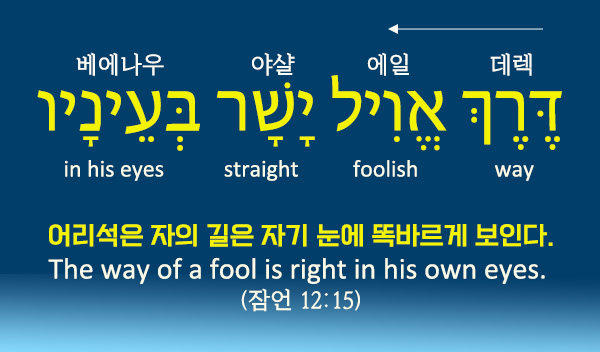
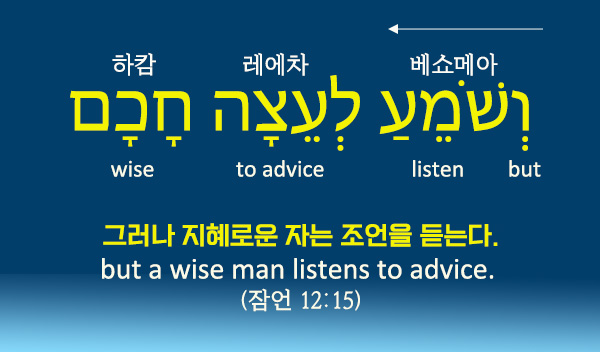
자신의 생각이 기발하고 뭔가 탁월한 아이디어, 대단한 아이디어를 생각하는 그런 사람이 지혜로운 사람이고 그런 생각을 할 수 없는 사람을 가리켜서 어리석은 사람이라고 말하는 것이 아니고, 누가 어리석은 사람인가? 자기가 하는 일, 자기가 가고 있는 길, 자기가 하는 그 방법 그것이 옳다, 잘못된 게 없다고 생각하는 사람은 어리석은 사람이라는 것입니다. 그럼 지혜로운 사람은 무엇인가? 다시 한번 12장 15절 말씀 뒤를 살펴보죠. “지혜로운 자는 권고를 듣느니라.” 권고를 듣느니라. 권고를 듣는다고 하는 이야기는 무슨 얘기입니까? 내가 생각하고 있었던 것이 옳지 않을 수도 있겠구나, 내가 이게 옳을 거라고 생각했던 바로 그것이 잘못되었을 수도 있겠구나, 잘못된 방법일 수 있겠구나라고 하는 사실을 인정하는 사람인 것이죠. 누가 지혜로운 사람인가? 마음이 닫혀 버려서 그래서 다른 사람들의 이야기를 듣지 않는 그런 사람은 어리석은 사람이고, 지혜로운 사람은 어떤 사람인가? 내가 실수할 수도 있고 내가 잘못할 수도 있다고 하는 가능성을 열어두고서 다른 사람들이 하는 이야기에 귀를 기울일 줄 아는 사람이 지혜로운 사람이라고 가르쳐 주고 있습니다.
여러분들은 권고를 잘 듣는 편입니까? 남의 말을 잘 안 들으시는 편입니까? 대체로 여성분들이 지혜로워서 잘 들으시잖아요? 남성분들은 대체로 안 들으시고. 왜 우리는 다른 사람들의 권고를, 조언을 듣지 않는 것일까요? 그것은 내가 옳다고 생각하기 때문입니다. 내가 옳다고 생각하는 이상, 내 길이 바르다고 생각하는 이상 다른 사람들의 말이 우리들의 귀에 들리지 않는 것인데요. 우리가 권고를 들어야 하는 이유, 다른 사람들의 조언을 들어야 하는 이유가 무엇이냐면 우리가 생각했던 그 생각, 우리가 판단했던 그 판단이 잘못될 수도 있기 때문입니다.
우리는 왜 다른 사람들의 조언을 들어야 할까요? 그것은 우리가 어떤 입장이냐면 마치 커다란 코끼리를 만지면서 코끼리가 어떻게 생겼는가 궁금해하는 여섯 명의 맹인과 같은 사람들이기 때문에 그렇습니다. 맹인 여섯 명이 코끼리를 붙들고 이 코끼리가 어떻게 생겼는가를 하나씩 만져보는 겁니다. 어떤 맹인은 코끼리의 다리를 만졌습니다. 그러면서 하는 말이 코끼리는 나무둥치와 같다고 이야기를 하는 것이죠. 그런데 어떤 맹인은 코끼리의 코를 만집니다. 코를 만지면서 하는 말이 코끼리는 마치 뱀과 같다고 이야기를 하는 거예요. 어떤 맹인은 코끼리의 귀를 만지면서 코끼리는 마치 넓은 잎사귀와 같다고 말하는 것이죠. 어떤 맹인은 코끼리의 몸을 만지면서 코끼리는 마치 커다란 바위와 같다고 이야기를 하는 겁니다.
맹인이 만지는 그 코끼리는 모두 코끼리의 일부분들입니다. 그런데 그 코끼리의 일부분을 만져 놓고 그 맹인들은 확신에 차 있는 거죠. 내가 안 만진 것도 아니고 경험해 보지 않은 것도 아니고, 내가 경험했고 내가 만져봤고 내가 이렇게 느꼈기 때문에 코끼리는 확실히 나무둥치다, 확실히 뱀과 같다, 잎사귀와 같다고 말합니다. 자기가 경험한 대로 이야기를 하면서 다른 사람들이 하는 말에 대해서 전혀 받아들이지 않는 겁니다. 무슨 소리냐고, 내가 만졌을 때는 분명히 나무둥치와 같았는데 코끼리가 뱀같이 생겼다니 그런 어리석은 소리가 어디 있느냐, 코끼리가 잎사귀와 같다니 그런 어리석은 소리가 어디 있느냐고 상대방을 비난하는 겁니다. 맹인 여섯 명이 서로 싸우면서 자기 생각이 옳다고 이야기하고, 다른 사람들이 진리의 일부분을 보았을 것이라는 사실을 전혀 예상치 못한 채 내가 이해한 것만이 진리의 전부인 것처럼 옹고집을 부리고 있는 것이이죠.
그런데 진리가 무엇입니까? 진리가 클까요, 우리의 머리가 클까요? 진리는 우리의 머리통보다 훨씬 커요. 우리가 그 진리를 우리의 머리로 다 이해할 수가 없는 것이죠. 우리의 머리로 이 세상의 이치를 다 깨달을 수 없고, 우리는 겨우 엄청난 크기의 진리 가운데 일부분만을 보면서 이것이 진리라고 생각하고 있는 것이죠. 그런데 그것을 경험하지 않은 것이 아니라 내가 직접 경험했고 직접 연구했기에 이것이 전부라고 생각하면서, 내가 생각하는 것이 옳고 다른 사람이 생각하는 것은 틀렸다고 말하며 다른 사람들이 하는 이야기에 전혀 귀를 기울이지 않는 것입니다.
문제가 어디에 있습니까? 코끼리를 내가 다 만진 것이 아니라는 데 문제가 있습니다. 우리는 코끼리의 일부분만을 만졌을 뿐이고, 내가 만지지 아니한 다른 부분을 다른 사람들이 만지고 있었고 그것을 보았다고 하는 점을 우리가 이해해야 할 것입니다. 똑같은 사물을 놓고 서로 다른 이야기를 하는 겁니다. 원통을 위에서 본 사람은 이것은 동그라미라고 강하게 주장하는데, 옆에서 바라본 사람은 원통은 직사각형이라고 강하게 주장하고 있어요. 그런데 이 동그라미라고 주장하는 사람의 주장과 직사각형이라고 주장하는 사람의 주장이 도무지 양립할 수 없고, 동그라미와 직사각형이 어떻게 일치할 부분이 어디 있어요? 그 둘이 합쳐질 가능성이 전혀 없을 것이라고 생각하면서 서로 싸우고 있는데, 알고 보면 똑같은 원통을 어떤 사람은 위에서 바라보고 있는 것이고 어떤 사람은 옆에서 바라보고 있는 것이죠. 자기가 바라본 그 입장에서 그것을 판단하고 있기 때문에 서로 자기 자신이 옳다고 생각하고 있는 것입니다.
그러기에 지혜로운 사람은 무엇인가? 아하! 내가 진리를 전부 파악한 것이 아니라 진리의 일부분만을 보았을 뿐이고, 그래서 내가 보지 못한 다른 면의 진리를 나와 정반대의 생각을 가지고 있는 저 사람이 보았을 수도 있을 것이라고 하는 그런 겸손한 마음을 가지고 귀를 기울여야 하는 것이죠. 어떠한 일을 함에 있어서 내가 100% 확실하다고 생각이 든다고 할지라도, 이것이 내 눈에 옳다고 생각이 되는 그 순간에라도, 다른 사람들은 어떻게 바라보고 있으며 어떻게 생각하는지 그 사람들의 이야기에 귀를 기울일 필요가 있는 거예요.
잠언 15장 22절 말씀 가운데 이렇게 기록합니다. “의논이 없으면 경영이 무너지고 지략이 많으면 경영이 성립하느니라.” 많은 사람이 한 계획을 놓고서 서로 이야기를 하고, 이 계획에 대해서 이렇게 하면 어떻겠는가 저렇게 하면 어떻겠는가 서로 이야기를 하게 될 때 그 계획이 성공하게 되는 것이지만, 어떤 계획을 세우면서 다른 사람들의 이야기를 전혀 듣지 않고 내가 생각하는 대로 밀어붙이게 된다면 그 계획은 실패할 가능성이 많다고 잠언 15장 22절 가운데서 말씀해 주고 있습니다.
지혜로운 사람은 다른 사람들이 하는 이야기에 귀를 기울이고, 내가 생각했던 것이 잘못될 수도 있겠다고 하는 가능성을 열어놓고 조언에 귀를 기울이는 사람입니다. 어리석은 사람은 내가 생각한 것이 옳다 생각하고 다른 사람들의 의견은 전혀 들어보지도 않고 끝까지 밀어붙이는 사람입니다. 우리 모두가 다 솔로몬처럼 기발한 아이디어를 낼 수 있는 것은 아닙니다. 대부분은 다 엇비슷하고 비슷비슷합니다. 그럴 때 우리는 어떻게 지혜롭게 행할 수 있겠는가? 내가 생각한 대로 그냥 혼자 결정하고 밀어붙이는 것이 아니라, 같이 생각하고 대화하고 같이 일을 의논해서 만들어 가는 것이 바로 성경적인 원리라고 하는 사실을 기억하시길 주님의 이름으로 축원합니다.
안타까운 것은 우리들이 대부분 의견을 구하지 않아요. 조언을 구하지 않아요. 제가 다른 사람을 바라볼 때에도, 저 후배가 목회의 길을 가면서 이러한 상황에 어떻게 했으면 좋을지 나한테 와서 한번 물어봤으면 좋겠는데, 묻지 않고 그냥 혼자 결정합니다. 내가 볼 때는 이거 참 위험한 길이고 저렇게 가다가는 큰일 날 수 있겠는데, 전혀 묻지 않고 그냥 자기 길로 가버리는 거예요. 우리 성도들 가운데서도 많은 사람이 그냥 자기가 생각하는 대로 밀어붙이다가 망하는 겁니다. 내가 신앙생활 하는 가운데 어떻게 해야 할 것인가? 성경 공부를 더 하고 싶다면 와서 물어봐야죠. “목사님 성경 공부를 어떻게 하면 좋겠습니까? 내가 여기를 다니고 싶은데 다녀도 괜찮습니까? 이것은 어떻게 생각하십니까?” 물어봐야죠. 안 물어보고 혼자 자기 생각으로 밀어붙이면서, 절대로 돌이킬 수 없는 루비콘강을 건너가 버리는 결정을 해버리고 난 다음에 더 이상 돌이킬 수도 없는 길로 가버리는 경우들이 얼마나 많은지 몰라요.
하나님께서 남자와 여자를 한 가정으로 만들어 주시고 부부로 만들어 주신 이유는 남편과 아내가 서로 다른 것을 보기 때문입니다. 서로 생각이 다르고 의견이 다른데 어쩜 그렇게 다른지 몰라요. 똑같은 것이 거의 없어요. 그런데 안 맞는 게 정상이에요. 안 맞아야 내가 생각지 못했던 것을 상대방은 보고 있구나 깨닫게 되는 것이죠. 남편은 다른 것을 보고 있고, 아내는 다른 것을 보고 있구나 인정하는 것입니다. 어른의 시각만이 아니라 아이들의 시각도 보고, 일을 결정함에 있어서 너희들은 어떻게 생각하느냐 아이들에게도 물어보고 부모님들에게도 물어보고 친구들에게도 물어보면서, 과연 내가 생각지 못한 허점은 없는지, 예상치 못한 어려움은 없는 것인지 조언을 구해야 합니다.
안타깝게도 수많은 사람이 자기 자신을 드러내려고 하지 않고, 창피당할까 봐 혹은 무시당할까 봐 혼자만 고민하다가 잘못된 길로 가요. 내가 생각할 때는 분명히 이것 아니면 저것이기 때문에 다른 방법은 전혀 없다고 생각하고 절망해버리는 겁니다. 그런데 옆에 있는 사람이 보면 그 두 길만 있는 것이 아니라 더 좋은 다른 길이 있는 거예요. 내가 생각지 못한 더 완벽한 길이 옆에 있는 거예요. 그런데 나는 코끼리 다리만 만지고 보면서 답이 없구나 생각하며 좌절하고 절망해서 극단적인 선택을 하는 경우까지 가게 되는데, 지혜로운 사람은 솔로몬처럼 타고난 사람이 아니라 물어보는 사람입니다. 지혜로운 사람은 물어보는 사람입니다. 의견을 물어보고 다양하게 들어보는 자가 지혜로운 자요, 조언을 거부하고 자기 생각이 옳다고 생각하는 자는 어리석은 자라는 사실을 기억하시길 주님의 이름으로 축원합니다.
그런데 우리가 좀 생각해 봐야 할 것이 하나 있습니다. 우리나라 속담에 **“사공이 많으면 배가 산으로 간다”**는 말이 있기 때문입니다. 의견을 많이 듣다 보면 원하는 목적으로 가는 것이 아니라 엉뚱한 데로 갈 가능성도 있다는 것이죠. 그래서 우리 한국 사람들은 의견이 많은 것을 싫어하는 성향이 굉장히 강합니다. 말이 많으면 사공이 많아서 배가 산으로 간다고 말하고, 일사불란하게 “앞으로 가” “돌격 앞으로 가” 해야 무엇인가 이루어진다고 생각합니다. 그렇다면 의견이 많은 게 좋을까요, 없는 게 좋을까요? 많은 의견 때문에 토의하다가 아무것도 못 하는 게 좋을까요, 아니면 내가 생각하는 대로 밀어붙여서 성취를 향해 무조건 달려가는 것이 좋을까요?
다른 사람들의 의견을 들으라고 오늘 성경 말씀은 기록하고 있는데, 현실에서 이 말씀을 어떻게 적용하느냐 하는 것은 쉽지 않은 문제입니다. 성경에 보면 다양한 예가 나와 있습니다. 다윗은 사울을 죽일 수 있는 상황에서 “지금 사울 왕을 죽이십시오”라는 부하들의 조언을 듣지 않았고, 그것이 옳은 지혜로운 결정이었습니다. 예수님께서는 십자가를 지겠다고 하셨을 때 베드로가 말렸지만 그 조언을 물리치셨습니다. “사탄아 내 뒤로 물러가라” 하시며 십자가의 길을 가셨습니다. 바울 사도는 예루살렘에 가면 큰일 난다는 선지자의 간청을 무시하고 예루살렘을 향해 담대히 나아갔습니다. 욥은 하나님을 욕하고 죽으라는 아내의 조언을 듣지 않았습니다.
반대로 조언을 들었다가 잘못된 사람이 있습니다. 솔로몬의 아들 르호보암은 백성들의 노역을 줄여달라는 요청에 대해 같이 자라난 소년들의 조언을 들었습니다. 강하게 밀어붙여야 한다는 조언을 따랐다가 결국 남북 이스라엘로 나뉘는 불행한 결과를 가져왔습니다. 아브라함은 아내 사래의 말을 듣고 하갈에게 들어가 아기를 낳았다가 잘못된 결정을 내렸습니다.
그렇다면 들어서 잘된 경우도 있고 안 들어서 잘된 경우도 있는데 어떻게 해야 할까요? 예를 들자면 애굽 왕 바로는 요셉의 충고를 듣고 흉년을 대비하여 잘되었습니다. 나아만 장군은 이스라엘에서 잡혀 온 어린 소녀가 하는 말에 귀를 기울였다가 나병이 치유받는 놀라운 기적을 얻었습니다. 이스라엘 선지자가 요단강에 들어가라고 할 때 화가 나 돌아가려 했지만 부하의 조언을 듣고 병을 고친 것이죠. 반면 아합 왕은 미가야 선지자의 말을 듣지 않고 전쟁터로 나갔다가 결국 죽게 되었습니다.
성경에는 조언을 들어서 잘된 사람도 있고 망한 사람도 있습니다. 그렇다면 **“미련한 자는 자기의 행위를 바른 줄로 여기나 지혜로운 자는 권고를 듣느니라”**는 말씀을 어떻게 이해해야 합니까? 조언을 듣느냐 안 듣느냐보다 훨씬 더 중요한 것은 그 조언이 옳은 조언인가 아닌가 하는 것입니다. 옳은 조언이라면 반드시 들어야 하겠지만, 우리를 넘어지게 하는 잘못된 조언이라면 듣지 않아야 하는 것이죠. 무조건 조언을 들으라는 의미가 아니라, 좋은 조언을 듣기 위한 전제 조건인 **“내가 생각한 것이 잘못될 수도 있다”**는 겸손한 자세를 가지라는 것입니다. 내가 옳다는 확신에 차 있으면 어떤 좋은 조언도 듣지 않을 것입니다. 하지만 내가 잘못될 가능성이 있다는 것을 인정하면 조언에 귀를 기울이게 될 것입니다.
사람들은 너무나도 어리석고 자기 자신이 옳은 줄로 착각을 해서 눈이 멀어버리고 귀가 막혀버립니다. 진리가 있지만 보는 것이 아니라 내가 보고 싶은 것만 보고 듣고 싶은 것만 듣는 상태가 되어버립니다. 그것이 우상을 닮아버린 상태입니다. 시편 135편 15절에서부터 18절 말씀에 보면 이런 말씀이 있습니다. “열국의 우상은 은금이요 사람의 손으로 만든 것이라 입이 있어도 말하지 못하며 눈이 있어도 보지 못하며 귀가 있어도 듣지 못하며 그들의 입에는 아무 호흡도 없나니 그것을 만든 자와 그것을 의지하는 자가 다 그것과 같으리로다.” 우상을 섬기면 우상을 닮아가는데 눈이 있어도 보지 못하고 귀가 있어도 듣지 못하게 됩니다. 교만해지면 진리를 이야기해 주어도 듣지 않게 되고 그래서 망하게 되는 것입니다.
사람들은 왜 망할까요? 내가 옳다고 생각하기 때문에 망합니다. 내가 옳다고 확신하는 순간 진리에 대해 눈을 감고 귀를 닫아버리는 우상과 같은 상태가 되기 때문입니다. 우리 주변의 모든 조언을 100% 다 들을 것은 아닙니다. 나쁜 조언이 훨씬 더 많을 수도 있습니다. 하지만 남의 말을 안 듣는 독불장군도 문제이고 귀가 얇은 팔랑귀도 문제이지만, 무엇이 진리인가가 훨씬 더 중요합니다. 그 진리에 다가가기 위해서는 “내가 잘못 생각했을 수도 있구나, 내가 옳지 못한 판단을 했을 수도 있구나” 하는 겸손한 마음이 전제되어야 합니다.
안타깝게도 우리는 죄성으로 가득 차 있어서 겸손하지 못합니다. 내가 항상 옳다고 생각하는 것은 죄성으로부터 비롯된 것임을 깨닫고 예수 그리스도의 십자가 앞에 나아가야 합니다. 주님 저희들의 교만한 마음을 녹여주셔서 내가 잘못될 수도 있다는 사실을 발견하게 하시고, 진리를 들을 때 귀를 닫아버리는 어리석은 모습 보이지 않게 저희들의 마음을 바꾸어 주옵소서. 주님 앞에 겸손한 마음으로 기도하며 나아가는 우리 모두가 되기를 주님의 이름으로 축원합니다.
The Wise and the Foolish: The Wisdom of Listening to Counsel
Who is a wise person, and who is a foolish person? When we think of a wise person, Solomon often comes to mind. There is a famous incident that demonstrates just how wise he was. One day, two women brought a baby to him, asking for a judgment. Both women claimed to be the child’s real mother, and Solomon had to determine who was telling the truth. If such a case occurred today, a DNA test could easily settle the matter. However, at that time, the infant’s features were not yet fully formed, making it difficult to identify the parent by appearance alone. In that difficult situation, Solomon brilliantly found a way to identify the woman with true maternal love. He discovered who was lying and who the real mother was, and rendered his judgment accordingly.
Everyone marvels at Solomon’s wisdom—the way he wisely solved a complex problem that no one else could fathom. When we think of a “wise person,” we often imagine someone with that kind of extraordinary wisdom, someone overflowing with ingenious ideas and exceptional thoughts. We tend to think that only such a person is truly wise.
However, today’s scripture tells us something quite surprising. In this passage, which deals with the questions, “What is a foolish person like? Who is the foolish person? Who is the wise person?”, it describes the foolish person as someone who believes their own way is right. Let us look at Proverbs 12:15 again: “The way of a fool is right in his own eyes.” A fool thinks that what he does is correct; he believes there is nothing wrong with his actions and considers them upright.
I would like us to look at the original text. The Hebrew wording, “Derekh ewil yashar be’einaw,” can be interpreted as: “The way of a fool appears straight in his own eyes.” It is an expression meaning that, in the fool’s own estimation, his path looks perfectly straight. Our revised version translates this as the fool “considering his own conduct to be right.”
Wisdom is not defined here as having brilliant thoughts or grand, exceptional ideas. A person is not called “foolish” simply because they lack such ingenuity. Rather, who is the foolish person? It is the one who thinks that whatever they do, whatever path they take, and whatever method they use is correct and flawless. Then what is a wise person? Let us look at the latter half of Proverbs 12:15: “…but a wise man listens to advice.” He listens to counsel. What does it mean to listen to counsel? It means being a person who admits, “What I was thinking might not be right after all. What I believed to be correct might actually be a mistake or a wrong method.” Who is the wise person? A foolish person is someone whose heart is closed, so they do not listen to others. But the Bible teaches that a wise person is someone who leaves open the possibility that they could make a mistake or be wrong, and knows how to listen to what others have to say.
Are you the type of person who listens well to counsel? Or do you tend not to listen to others? Generally, women are considered wise in this regard as they listen well, while men often do not. Why do we refuse to listen to the counsel or advice of others? It is because we think we are right. As long as we think we are right and our path is straight, the words of others do not reach our ears. The reason we must listen to counsel and advice is that our thoughts and our judgments might be wrong.
Why must we listen to the advice of others? It is because we are like the six blind men touching a large elephant, wondering what it looks like. Six blind men hold onto an elephant and touch it one by one to figure out its shape. One blind man touches the elephant’s leg and says the elephant is like a tree trunk. Another touches the trunk and says the elephant is like a snake. One touches the ear and says the elephant is like a broad leaf. Yet another touches the body and says the elephant is like a great rock.
Everything these blind men touch is a part of the elephant. However, after touching only a part, they are filled with certainty. They think, “It’s not as if I haven’t touched it or experienced it. Because I have felt it myself, the elephant is certainly like a tree trunk, a snake, or a leaf.” They speak according to their experience and refuse to accept what others say. They criticize others, saying, “What are you talking about? When I touched it, it was clearly like a tree trunk. How can you say it looks like a snake? That’s nonsense! How can it be like a leaf?” They argue with one another, each insisting they are right. Without ever considering that others might have seen a portion of the truth, they stubbornly persist as if their limited understanding is the whole truth.
But what is the truth? Is the truth bigger, or is our head bigger? The truth is much larger than our heads. We cannot understand the entirety of truth with our minds alone. We cannot grasp all the logic of this world; we only see a fragment of a vast truth and mistake it for the whole. Yet, because we have experienced and researched it ourselves, we think it is everything. We believe our thoughts are right and others are wrong, and so we stop listening to what they say.
Where is the problem? The problem is that we have not touched the whole elephant. We have only touched a part, and we must understand that others were touching and seeing different parts that we did not touch. People can say different things about the same object. Someone looking at a cylinder from the top will strongly insist it is a circle. But someone looking at it from the side will strongly insist it is a rectangle. The claims of the person seeing a circle and the one seeing a rectangle seem irreconcilable. They fight, thinking there is no possibility of these two shapes being the same thing. However, in reality, they are looking at the same cylinder—one from above and one from the side. Because they are judging from their own perspective, they each believe they are right.
Therefore, what is wisdom? It is having the humble heart to say, “Aha! I haven’t grasped the whole truth; I’ve only seen a part of it. Perhaps that person, who has the opposite view of mine, has seen a side of the truth that I missed.” We must listen. Even if we feel 100% certain about something, even at the moment we think we are right, we need to listen to how others perceive and think about it.
Proverbs 15:22 records: “Without counsel plans fail, but with many advisers they succeed.” When many people discuss a plan and talk about different ways of doing things, that plan succeeds. However, Proverbs 15:22 tells us that if you make a plan but refuse to listen to others and just push forward with your own thoughts, that plan is likely to fail.
A wise person is one who listens to what others say, leaves open the possibility that their own thoughts might be wrong, and pays attention to advice. A fool is someone who thinks they are right, refuses to even listen to the opinions of others, and pushes through to the end. Not all of us can come up with ingenious ideas like Solomon. Most of us are quite similar in our thinking. In such cases, how can we act wisely? I bless you in the name of the Lord to remember this biblical principle: wisdom is not deciding and pushing through alone, but thinking, talking, and discussing together to build things up.
It is regrettable that most of us do not seek opinions. We do not seek advice. Even when I look at others—for instance, when a junior colleague is walking the path of ministry—I wish they would come and ask me what to do in a certain situation, but they often just decide on their own. From my perspective, I can see that it is a dangerous path and could lead to trouble, but they go their own way without asking. Many among our congregants also face ruin because they simply push forward with their own thoughts. How should we conduct our lives of faith? If you want to study the Bible more, you should come and ask. “Pastor, how should I study the Bible? I want to attend this place; is it okay to go? What do you think about this?” You should ask. Instead of asking, many people push forward with their own ideas, cross the metaphorical Rubicon, and end up on a path from which they can no longer return.
The reason God created man and woman as a family and made them a couple is that husbands and wives see different things. Their thoughts and opinions are different—and it is amazing how different they can be! There is almost nothing they agree on perfectly. But it is normal not to match. Only when you don’t match can you realize, “The other person is seeing something I didn’t think of.” It is admitting that the husband sees one thing and the wife sees another. We should seek advice not only from an adult’s perspective but also from a child’s perspective. When making a decision, ask your children, “What do you think?”, ask your parents, and ask your friends. We must seek counsel to see if there are flaws we haven’t considered or unexpected difficulties.
Sadly, many people do not want to reveal themselves. Fearing embarrassment or being looked down upon, they worry alone and end up on the wrong path. They think, “It’s clearly either this or that,” and believe there is no other way, falling into despair. But when someone else looks at it, they see that there are not just those two paths, but an even better third path. A more perfect path that you hadn’t considered is right there. Yet, by only touching the elephant’s leg, you think there is no answer, become frustrated, and can even reach the point of making an extreme choice. A wise person is not someone born gifted like Solomon, but someone who asks. A wise person is someone who asks. I bless you in the name of the Lord to remember that the one who asks for opinions and listens to diverse views is wise, while the one who rejects advice and thinks only their own thoughts are right is foolish.
However, there is one thing we should consider. There is a Korean proverb that says, “If there are too many sailors, the boat goes to the mountain.” This means that if you listen to too many opinions, you might end up in a completely different place than your intended destination. Because of this, Koreans often have a strong tendency to dislike having too many opinions. They think that if there are too many sailors, the boat will go to the mountain, and that things can only be accomplished through a “charge forward” mentality with singular focus. So, is it better to have many opinions or none? Is it better to do nothing because you are debating many views, or is it better to push forward with your own thoughts and run toward achievement at any cost?
While today’s scripture tells us to listen to the opinions of others, applying this in reality is not an easy matter. The Bible provides various examples. In a situation where he could have killed Saul, David did not listen to the advice of his subordinates who said, “Kill King Saul now,” and that was a righteous and wise decision. When Jesus said He would bear the cross, Peter tried to stop Him, but Jesus rejected that advice. He said, “Get behind me, Satan!” and walked the path of the cross. The Apostle Paul ignored the pleas of a prophet who warned that trouble awaited him in Jerusalem, and he went forward boldly. Job did not listen to his wife’s advice to curse God and die.
On the other hand, there are those who went wrong because they listened to advice. Rehoboam, the son of Solomon, listened to the advice of the young men he grew up with regarding the people’s request to lighten their labor. By following the advice to be harsh, he brought about the unfortunate result of Israel being divided into North and South. Abraham listened to his wife Sarai’s words, went to Hagar, and made a wrong decision that resulted in the birth of Ishmael.
So, there are cases where people succeeded by listening and cases where they succeeded by not listening. What should we do? For example, Pharaoh, the King of Egypt, succeeded because he listened to Joseph’s advice and prepared for the famine. General Naaman listened to the words of a little girl captured from Israel and received the amazing miracle of being healed of leprosy. When the prophet of Israel told him to enter the Jordan River, he was angry and about to leave, but he listened to his servant’s advice and was healed. Conversely, King Ahab refused to listen to the prophet Micaiah, went to the battlefield, and eventually died.
In the Bible, some people succeeded by listening to advice, and others were ruined. Then how should we understand the verse: “The way of a fool is right in his own eyes, but a wise man listens to advice”? What is much more important than whether you listen to advice or not is whether that advice is correct. If it is right advice, you must listen; but if it is wrong advice that causes you to stumble, you must not listen. This does not mean you should listen to advice unconditionally. Rather, it means you should have the humble attitude: “What I have thought might be wrong.” This is the prerequisite for hearing good advice. If you are filled with the certainty that you are right, you will not listen to any good advice. But if you admit the possibility that you could be wrong, you will pay attention to counsel.
People are so foolish; they mistake themselves for being right, becoming blind and deaf. Truth exists, but they end up only seeing what they want to see and hearing what they want to hear. This is a state of becoming like an idol. Psalm 135:15–18 says: “The idols of the nations are silver and gold, made by human hands. They have mouths, but cannot speak, eyes, but cannot see. They have ears, but cannot hear, nor is there breath in their mouths. Those who make them will be like them, and so will all who trust in them.” If you worship an idol, you become like the idol—having eyes but not seeing, and having ears but not hearing. If you become proud, you won’t listen even when the truth is told to you, and thus you face ruin.
Why do people face ruin? They face ruin because they think they are right. The moment they are certain of their own correctness, they become like an idol, closing their eyes and ears to the truth. We should not listen to 100% of all the advice around us. There might be much more bad advice than good. However, while being a “maverick” who doesn’t listen to anyone is a problem, being “thin-eared” and easily swayed is also a problem. What is far more important is: what is the truth? To draw closer to that truth, you must start with a humble heart that says, “I might have thought wrongly; I might have made an incorrect judgment.”
Unfortunately, we are full of a sinful nature and lack humility. We must realize that thinking we are always right stems from our sinful nature, and we must go before the cross of Jesus Christ. “Lord, melt our proud hearts so that we may discover the fact that we could be wrong. Change our hearts so that we do not show the foolishness of closing our ears when we hear the truth.” I bless you in the name of the Lord that we all become those who go forward praying with a humble heart before the Lord.
