성경에 자주 등장하는 또 하나의 문학적인 기법이 있는데요. 그것을 가리켜서 교차 대칭 구조라고 하는 문학적인 기법이 있습니다. 그동안에 이 기법이 한 번도 나오지 않은 것이 아니라 자주 등장하고 여러 번 등장했지만, 그것을 설명할 기회가 마땅치 않아서 설명하지 않고 그냥 지나쳐 왔었는데요. 오늘은 교차 대칭 구조에 대해서 한번 살펴보면서 오늘 잠언서의 말씀을 묵상해 보려고 합니다. 도표를 한번 먼저 보여줬으면 좋겠는데요.
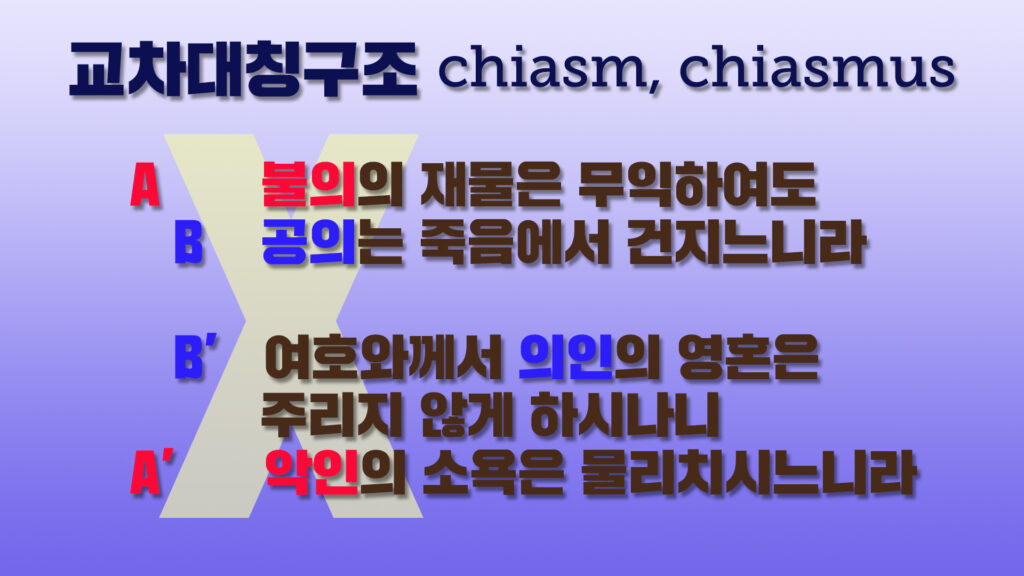
교차 대칭 구조라고 하는 것은 영어로는 카이어즘(chiasm), 독일어로는 키아스무스(chiasmus)라고 하는 것입니다. 키(chi)라고 하는 것이 헬라어 알파벳으로 ‘X’ 자와 같은 것이죠. 그런데 문장을 배열하는 것이 마치 ‘X’ 자를 배열하는 것처럼 문장을 배열한다고 해서 “카이어즘” 또는 독일어로는 “키아스무스”라고 하는 말로 표현하는데, 그것을 우리나라 말로는 “교차 대칭 구조”라고 하는 말로 번역할 수가 있겠습니다.
지금 보여주고 있는 구절이 몇 절이냐면 오늘 읽은 말씀 잠언 10장 2절과 3절의 말씀입니다. 먼저 이렇게 이야기를 하죠. “불의의 재물은 무익하여도” 이것이 하나의 주제를 이야기하고 있는 것이죠. 두 번째 주제를 이야기합니다. “공의는 죽음에서 건지느니라.” 두 번째 주제를 이야기한 다음에 다시 첫 번째 주제로 돌아가는 것이 아니라, 조금 전에 금방 말했던 두 번째 주제를 약간 변형해서 다시 이야기를 하고 있는데요. “여호와께서 의인의 영혼은 주리지 않게 하시나니” 한 다음에 다시 첫 번째 주제로 되돌아가는 겁니다. “악인의 소득은 물리치시느니라.” 그러니까 제가 ‘X’ 자를 쳐서 표기를 해놓았습니다마는, 그 구조가 A-B-B’-A’라고 하는 그런 구조로 이렇게 이루어져 있는 문장을 가리켜서 “교차 대칭 구조”라고 할 수가 있겠습니다.
성경에 있는 기법만이 아니라 서양의 언어에서는 아주 자주 등장하는 기법이고요. 히브리어를 비롯한 이스라엘 주변의 중동 지역의 언어들에서 자주 사용하는 그런 표현법이 바로 교차 대칭 구조의 구조 기법이라고 할 수가 있겠습니다. 예전에 제가 설명해 드렸던 것처럼 히브리 평행법이 여기에도 그대로 드러나 있는 것을 알 수가 있겠는데요. 그러니까 지금 표현하고 있는 겁니다. 불의의 재물이 무익하다. 불의의 재물, 다시 말하자면 불의로 얻은 재물이라고 하는 것은 우리에게 결코 유익한 게 아니다고 말한 다음에, 그것에 반대되는 말인 악인의 소욕은 하나님께서 물리치신다고 이야기하고, 다시 악인의 소유에 관해서 다시 또 반복해서 설명하는 것이, 공의는 죽음에서 건지지만 그러나 “여호와께서 의인의 영혼은 주리지 않게 하시나 악인의 소욕은 물리치시느니라”라고 해서 이 표현이 나오고 반복되는 모습을 볼 수가 있겠습니다.
그래서 여기서 보면 2절 말씀에 “불의의 재물은 무익하여도 공의는 죽음에서 건지느니라”라고 말하고 있는데, 공의가 죽음에서 건져낸다는 말은 무슨 말입니까? 그것은 우리가 그냥 생각하기로는 “아, 이것은 그냥 공의롭게 행하면, 의롭게 행하면 우리를 죽음에서 건져내는 것이다”라고 생각하기가 쉽지만, 오늘 이 교차 대칭 구조로 이해를 한다고 한다면 이것은 “공의롭게 얻은 재물”을 의미하는 겁니다. 불의로 얻은 재물은 무익하게 될 것이지만, 그러나 공의롭게, 정의롭게, 바른 방법을 사용해서 얻은 그런 재물은 우리를 구원하는 것이다, 죽음에서 건지는 것이라고 설명하고 있습니다. 재물을 얻는 과정 가운데서 의롭게, 의로운 방법을 사용해서 얻어야 그것이 우리가 사는 길이라고 하는 것을 말씀해 주고 있는 것입니다.
우리가 재물을 얻는 방법은 두 가지 방법이 있을 것입니다. 첫 번째는 우리가 옳은 길을 통해서, 바른 길을 통해서 재물을 얻는 것입니다. 예를 들자면 우리가 수고하고 애쓰고 노력해서 최선을 다해 일을 함으로 말미암아 그런 땀의 수고로서 얻는 재물이라고 하는 것은 의로운 방법으로 재물을 얻는 것이라고 할 수가 있겠습니다.
하지만 옳지 않은 방법을 통해서도 우리가 재물을 얻을 수가 있겠는데요. 그것은 불의의 재물이라고 할 수 있겠는데, 불의의 방법으로 재물을 얻는 것은 무엇이 있겠습니까? 예를 들자면 도둑질을 한다거나 사기를 친다거나 속임수를 쓴다거나 여러 가지 잘못된 방법으로, 사악한 방법으로 재물을 얻는다면 그것은 결국 무익하게 될 뿐이라고 오늘 성경 말씀 가운데서 가르쳐주고 있습니다.
우리들의 마음 가운데는 수단과 방법을 가리지 않고 그저 재물만 획득하기만 하면 된다는 생각이 지배적입니다. 우리 속담 가운데 “모로 가도 한양만 가면 된다”라는 말이 있습니다. 한양으로 가기만 하면 되는 것이지 이 길로 가든 저 길로 가든 어느 길로 가든 그 아무 상관이 없다, 결국 도착하는 지점이 한양이기만 하다면 모로 간다고 해도 괜찮은 것이라고 하는 그런 생각이 우리들의 마음 가운데 가득 지배하고 있는데요. 그래서 우리가 재물을 얻을 수만 있다면 그 방법이 공의로운 방법이든 공의롭지 못한 방법이든 어떠한 방법이든 그냥 재물만 얻을 수 있다면 좋다는 그런 생각들이 우리들의 마음 가운데 많이 있습니다.
뿐만 아니라 우리나라 사람들이 흔히 하는 말 가운데 하나가 무엇이 있느냐 하면 “꿩 잡는 것이 매다”라는 말이 있습니다. 그러니까 꿩만 잡을 수 있다면 그거면 된다는 것이죠. 꿩을 잡을 수만 있으면 그게 매인 것이지 꿩을 잡지 못한다면 그건 아무 소용이 없다고 생각하는 것이 우리들의 일반적인 생각이고, 결과가 좋다면 그 과정이야 어땠든지 결과가 이야기해 주는 것이지 결과가 좋지 못하다면 아무 의미가 없다고 하는 그런 결과 중심적인 생각들이 우리들에게 많이 팽배해 있습니다.
하지만 성경은 그러한 생각을 철저하게 반대하고 있고 배제하고 있습니다. 결과만 좋으면 좋은 것이 아니라 성경적인 관점은 과정이 훨씬 더 중요한 겁니다. 재물을 무슨 방법으로 얻었느냐가 재물을 얼마나 많이 가지고 있느냐보다 훨씬 더 중요하다고 성경은 이야기해 주고 있는 것인데, 바로 그것을 이야기하고 있는 것이 오늘 잠언 10장 2절과 3절의 말씀인 것입니다. 재물을 얻으면서 우리가 공의로운 방법으로, 의로운 방법을 통해서 재물을 얻어야 하는데 그렇지 않고 불의의 방법으로 얻게 된다면 그것은 옳지 않다는 말씀입니다.
하지만 이렇게 하는 것이 쉽냐면 그렇게 쉽지가 않습니다. 왜냐하면 불의의 방법을 사용하면 돈을 버는 것이 쉬워요. 남을 속이고 눈속임을 하고 하면 정말 많은 돈을 벌 수 있을 것 같아요. 동영상 같은 데 보면 동남아시아나 이런 데 가서 물건을 살려고 하면 좋은 이런 과일 같은 것이 막 쌓여져 있습니다. 그러면 그거 얼마 달라고 하면 열심히 담아서 저울 위에 딱 올려놓고 “여기 맞죠?” 하면서 더 줍니다 하면서 더 담는데, 그렇게 봉지를 담아가지고 그 봉지를 주느냐 하면 살짝 숨겨버리고 다른 봉투를 꺼내 가지고 그 다른 봉투를 준단 말이에요. 그런 눈속임을 통해서 소비자들을 우롱하는 그런 방법들을 통해서 돈을 번다면 다른 사람보다도 훨씬 더 많은 돈을 빠른 시간 안에 벌 수도 있을 것입니다.
하지만 공의로운 방법을 사용한다면, 정의로운 방법, 정직한 방법을 쓴다면 돈을 버는 것이, 재물을 버는 것이 쉽지 않습니다. 차곡차곡 차곡차곡 돈을 벌어야 되니까 그것처럼 어려운 것이 없는 것이죠. 따라서 우리가 의로운 방법을 써서 돈을 벌려고 한다면, 재물을 얻으려고 한다면 어느 세월에 우리가 이 많은 재물을 얻을 수 있을 것인가라고 하는 두려운 마음이 들게 되는 것이고, 이렇게 내가 정직하게 행하다가는, 의로운 길로만 가다가는 결국은 아무런 돈도 벌지 못하고 결국은 망하면 어떡하나라고 하는 그런 불안한 마음이 우리들 가운데 생기게 되는 겁니다. 그래서 사람들은 의로운 길로 가는 것이 아니라 불의한 길로 가게 되는 것이죠.
이런 생각을 가지고 있었던 것이 바로 이스라엘 민족의 생각이었습니다. 광야에서 생활하는 동안에 하늘에서 만나가 내립니다. 만나가 내릴 때 하나님께서 이스라엘 민족에게 해주셨던 명령이 무엇이냐면 “너희는 이 만나를 하루에 그날 먹을 분량만 거두라”라고 말씀해 주셨어요. 내일은 하나님께서 다시 내려주실 것이고 또 그다음 날은 또다시 내려줄 테니까 많이 거두지 말고 오늘 먹을 양식만 구하라고, 그렇게 거두라고 하나님께서 말씀해 주셨습니다. 하지만 이스라엘 민족은 그 말씀을 모세를 통해서 들었을 때 마음속에서 불안한 마음을 감출 수가 없는 거예요. 지금 이 만나가 우리들의 눈앞에 있는데 내가 많이 거두면 많이 거둘 수 있는 그런 만나가 지금 널려져 있는데, 내일을 위해서 내가 예비해 놓지 말라고 그랬다가 내일 만나가 안 내리면 어떡하나라고 하는 그런 걱정스러운 마음에 사람들은 만나를 이틀 치, 삼일 치 많이 거두어서 쟁여놓는 겁니다. 하나님의 뜻과 정면으로 대치되는 일들을 하면서 그래서 미래를 준비해 놓는 거죠. 왜 그렇습니까? 불안하기 때문에 그런 거죠. 내가 하나님의 말씀대로만 순종하면 내일은 굶을지도 모르겠다는 그런 불안한 생각 때문에 이스라엘 민족들은 하나님의 말씀을 어기면서 이틀 치, 삼일 치 만나를 거두게 된 겁니다.
하지만 그때 하나님께서는 이스라엘 민족을 훈련시키시기 위해서 남도록 거둔 모든 만나가 썩어서 냄새나게 하심으로 말미암아, 하나님의 말씀에 순종하며 사는 것이, 사람이 떡으로 살아가는 것이 아니라 하나님의 말씀에 따라 순종하며 사는 것이 그게 바른 길이라고 하는 사실을 40년 동안 배우며 훈련해야 했습니다.
어쩌면 우리가 이 세상에서 살아갈 때도 역시 마찬가지인데요. 우리가 하나님의 말씀대로 의로운 방법으로 옳은 길을 통해서 재물을 얻게 된다면 빨리 벌리는 것 같지 않기 때문에, 너무나도 더딘 것 같기 때문에 불안한 마음이 들어서 불의한 방법을 사용하고 싶은 마음이 문득문득 들 때가 있을 겁니다. 하지만 그때 재물과 관련한 하나님의 말씀을 우리들이 믿어야 될 줄로 믿습니다. 잠언 10장 3절 말씀, “여호와께서 의인의 영혼은 주리지 않게 하시나 악인의 소욕은 물리치시느니라.” 이 말씀을 우리들의 마음 가운데 깊게 간직할 수 있기를 주님의 이름으로 축원합니다. 여기서 말하는 의는 바로 의로운 방법으로 재물을 얻는 사람을 의미하는 것이고, 그렇게 하나님의 말씀에 따라 순종하며 재물을 얻는 자는 망할 것처럼 보여도 주리지 않게 하실 거라는 하나님의 말씀을 기억할 수 있기를 주님의 이름으로 축원합니다.
4절과 5절 말씀도 교차 대칭 구조로 되어 있습니다. 도표를 한번 보면 좋겠는데요.
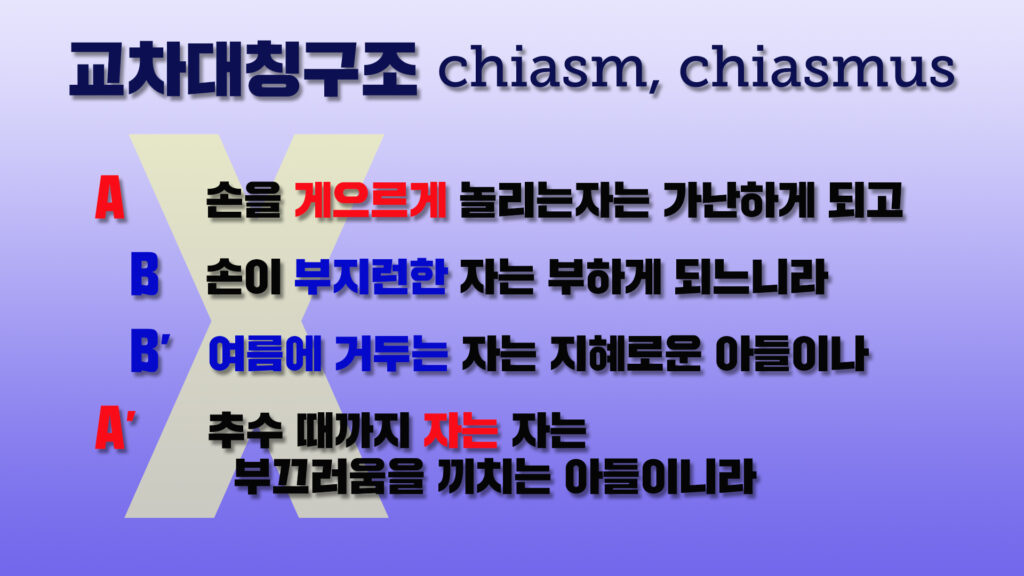
“손을 게으르게 놀리는 자는 가난하게 되고 손이 부지런한 자는 부하게 되느니라 여름에 거두는 자는 지혜로운 아들이나 추수 때에 자는 자는 부끄러움을 끼치는 아들이니라.” 여름에 거두는 사람은 어떤 사람인가요? 부지런한 사람인 것이죠. 추수 때에 자는 사람은 누구인가요? 손을 게으르게 놀리는 자인 것이죠. 그러니까 이렇게 교차 대칭 구조로 4절과 5절 말씀에서도 말씀해 주고 계십니다.
아주 간단한 원리고 누구나 다 알고 있는 원리를 말씀해 주고 계시는 겁니다. 게으른 자는 어떻게 되는가? 가난하게 된다는 겁니다. 부지런한 자는 어떻게 되는가? 부하게 될 것이라고 가르쳐주고 있는 겁니다. 여름에 거두는 자, 열심히 일을 해서 땀을 흘려가면서, 여름이라고 하는 그런 계절은 어떤 계절입니까? 너무나도 더운 날이고 힘든 날입니다. 그런데 게으르지 아니하고 열심히 일을 하면서 거두는 자는 결국 부하게 될 것이지만, 추수 때까지 기다리면서 차일피일 미루고 게으르게 자는 자는 결국 가난하게 될 것이라고 하는 어쩌면 보편적인 진리의 말씀을 여기서 해주고 있습니다. 우리 누구나 다 공감할 수 있는 원리일 것입니다. 그러니까 결론은 무엇이죠? 열심히 일해야 된다, 부지런하게 살아야 된다라고 하는 것이 오늘 교훈에서 해주신 말씀입니다.
물론 오해하지 않았으면 좋겠는데요. 우리가 쉬거나 혹은 잠을 자거나 혹은 휴가를 가거나 하는 것이 나쁘거나 무의미하다고 하는 그런 의미의 말씀은 결코 아닙니다. 우리는 균형을 맞추어야 하는데요. 성경적인 원리는 무조건 일만 많이 하는 것이 성경적으로 볼 때 가장 바람직한 모습이 아닙니다. 성경적인 원리는 일하고 또 적당할 때 쉬고, 또 일하고 또 쉬는 이 일과 쉼이 균형 있게 맞추어져야 그게 성경적으로 옳은 모습이죠. 육 일간 일을 했다면 하루는 쉬어야 하는 것이고, 하루 종일 낮에 일했다면 저녁때는 잠을 자면서 휴식을 취해야 하는 것이고, 우리가 마치 워크홀릭(workaholic)처럼 하루 종일 일하고 쉬지 않고 일하고 365일 쉬는 날 없이 계속 일만 해서 열심히 노력해 가지고 돈을 많이 버는 게 가장 바람직한 것이냐? 절대 그렇지 않아요.
하루 종일 일을 하면서 잠도 안 자고 자신의 육체를 혹사해 가면서 그렇게 열심히 부지런히 일해서 그렇게 돈을 많이 벌기만 하면 되느냐? 그게 절대 아니라는 거죠. 우리는 성경적인 교훈을 살펴볼 때 이 두 가지를 잘 살펴보아야 하는 것입니다. 오늘 잠언에서 부지런하게 살아야 한다는 것은 그만큼 우리가 일해야 되는 그 시간만큼은 아주 부지런하게 일을 해야 한다는 그런 의미이지, 절대 쉬어서는 안 된다, 쉼이 없어야 된다 하는 그런 의미의 말씀이 아닙니다.
성경에서는 오히려 쉬라고 말씀해 주고 있고, 특별히 십계명 가운데서 제사 계명은 너희가 안식일을 기억하여 거룩하게 지키고 쉬라고 말씀해 주고 있습니다. 하지만 사람들이 쉼이 없이 일하는 이유가 무엇입니까? 그것은 재물이 우상이 되어 버렸을 때 사람들은 쉼을 중단해 버립니다. 열심히 일을 하니까 돈이 많이 벌리거든요. 일한 만큼 결과가 나오니까 일을 많이 하면 더 많은 결과를 얻을 수 있는 것이고, 그러니까 돈이 우상이 되고 재물이 우상이 되면 일을 많이 하고 쉬지 않으면서 많은 돈을 얻으려고 하는 그런 모습을 보일 때가 있습니다. 그것은 벌써 우리에게 재물이 우상이 되었다는 증거인 것이죠. 따라서 성경은 일하면서도 동시에 쉬라고 말씀해 주고 있는 것이고, 그렇게 균형 잡힌 사람이어야 성경적으로 바른 삶을 살 수 있다고 할 수가 있겠습니다.
또 한편으로는 일하기 싫어하는 사람도 있는데 그것도 역시 잘못된 것이죠. 어떤 사람들은 일을 너무 열심히 해서 쉬지 않으려고 하는 반면, 어떤 사람들은 일하기를 싫어하고 그저 쉬려고만 합니다. 특별히 크리스천들 가운데서 그렇게 모습을 보이는 경우가 나타날 때도 있는데요. 성경을 오용하는 것이죠. 하나님께서 먹이고 입히시고 다 하는 것이니까 굳이 내가 이렇게 열심히 일할 필요 없다, 내일 일은 내일 걱정하고 하나님께서 다 먹이시고 입히시고 하는데 내가 뭐 일할 필요 있겠는가, 하나님은 까마귀를 통해서 보내주시는 거 아니겠는가, 그저 나는 하나님을 철저히 신뢰하면서 기도하기만 하면 된다고 생각하는 그런 사람들도 있습니다. 그런데 그것은 건전한 신앙이라고 할 수가 없는 것이죠.
하나님의 도우심이라고 하는 것은 우리가 손을 놓은 상태에서 그저 하나님께서 기적적으로 우리를 도와주시는 것만이 하나님의 도우심이 아닙니다. 이미 하나님께서는 우리에게 무엇을 주셨습니까? 손을 주셨어요. 발도 주셨어요. 하나님께서 우리에게 손도 주고 발도 주고 생각할 수 있는 머리도 주고, 이미 우리가 일을 해서 다 먹고 재물을 얻을 수 있는 그런 재능들을 하나님께서 다 주셨는데, 이미 그러한 은사를 우리에게 다 주셨는데 그것을 전혀 활용하지 않으면서 저 감나무에서 감이 내 입에 떨어지기를 바라듯이 입만 벌리고 있다면, 그것은 하나님께서 우리에게 손과 발을 주시고 머리를 주시고 모든 것을 주신 것을 망각한 행위라고 할 수가 있겠습니다.
초대교회에도 그런 사람들이 있었는데요. 초대교회 안에 들어온 사람들 가운데는 그저 일하지 않으면서 하나님께서 먹여주실 것을 기대했고, 또 교회가 자기를 도와줄 것을 기대하면서 교회의 도움만을 바라는 사람들이 초대교회 안에 있었습니다. 그럴 때 데살로니가후서 3장 10절에서부터 12절의 말씀을 통해서 이렇게 교훈해 주셨습니다. “우리가 너희와 함께 있을 때에도 너희에게 명하기를 누구든지 일하기 싫어하거든 먹지도 말게 하라 하였더니 우리가 들은즉 너희 가운데 게으르게 행하여 도무지 일하지 아니하고 일을 만들기만 하는 자들이 있다 하니 이런 자들에게 우리가 명하고 주 예수 그리스도 안에서 권하기를 조용히 일하여 자기 양식을 먹으라 하노라.” 초대교회 안에 들어와 있던 사람들 가운데 어떤 사람들은 그저 교회가 사랑으로 돌보아 줄 것만을 기대하면서 전혀 일하지 않고, 그저 내가 기도만 하기만 하면 그리고 형제들이 나를 도와주면 내가 먹고 살 수 있을 것이라고 생각하면서 의존적으로 살아가는 사람들이 있었는데, “아, 그거 괜찮다”라고 말씀한 것이 아니라 그런 사람들에게 주 안에서 권하기를 일하라, 수고해서 일해서 자기 손으로 흘린 노력과 땀을 통해서 먹을 것을 얻으라고 가르쳐주고 있습니다.
종종 우리 어떤 신앙인들 가운데는 그런 사람들이 있습니다. 자기가 어떤 경제적으로 어려운 상황에 처했을 때 그때 우리가 해야 될 일이 무슨 일입니까? 경제적으로 어려운 일을 당했다면 그 문제를 해결하기 위해서 일을 해야 하는 것이죠. 일을 하고 여러 가지 방법을 통해서 내가 땀을 흘려서 수고해서 얻을 수 있는 것을 얻어야 하는데, 종종 크리스천들 가운데는 어떤 사람들이 있냐면 나는 오로지 하나님만 의지하겠다고 하면서 내가 기도원에 가서 기도하기만 하면 하나님께서 응답해 주시겠지 하고, 하나님 앞에 “주님 돈을 주세요. 재정적인 문제를 해결해 주세요”라고 기도원에 가서 막 기도하고 그래서 어쩌다 보면 또 누가 도와주는 사람도 있으니까 하나님의 응답을 받았다고 이렇게 말하는 경우도 종종 있는데, 그것이 바른 자세가 아니라 오늘 잠언 10장에서 교훈하고 있는 것처럼 부지런하게 일해야 하는 것이고, 우리가 건전한 신앙을 가지고 있다면 수고하고 애쓰는 것이 당연하다고 하는 것을 기억할 수 있기를 주님의 이름으로 축원합니다.
안타깝게도 우리는 지혜롭지 못해서 오늘 말씀에 따라 순종하기보다는 의로운 방법을 통해서 소득을 얻기보다는 불의한 방법을 통해서 소득을 얻게 되는 방법으로 나갈 때가 많습니다. 또한 어떤 때는 우리가 게으른 모습으로 변하게 될 때가 있습니다. 그게 우리들의 문제인 것이죠. 그래서 그런 생각이 들 때마다 주님의 십자가 앞에 나가서 주님 앞에 회개하고 또한 도와달라고 기도하면서, “주님, 하나님께서 주신 그 삶을 잘 살아갈 수 있도록, 지혜롭게 살아갈 수 있도록 부지런할 수 있게 해주옵소서. 주님의 뜻에 따라 건강하게, 또한 주님의 뜻에 따라 옳은 방법으로 재물을 얻을 수 있도록 인도해 주시고, 내 마음이 불안해서 이렇게 살다가는 내가 망할지도 모르겠다, 하나님의 뜻대로 살다가는 혹시 내가 굶을지도 모르겠다고 하는 그런 위험한 생각이 들 때 여호와 하나님께서는 의롭게 일하는 자를 주리게 하지 않는다고 하는 이 말씀을 믿을 수 있게 하여 주옵소서” 기도하며 나아가는 우리 모두가 다 될 수 있기를 주님의 이름으로 축원합니다.
Righteous Gains: Why the Process Matters More Than the Result
There is another literary technique that frequently appears in the Bible; it is known as the chiastic structure (or chiasmus). This technique has appeared many times before, but as I haven’t had the proper opportunity to explain it, I have passed over it until now. Today, I would like to explore this chiastic structure while meditating on the words of Proverbs. First, I would like to show you a diagram.
The chiastic structure is called chiasm in English and chiasmus in German. The root word chi refers to the Greek letter that looks like an “X.” This technique is named because the arrangement of sentences follows a pattern similar to the shape of an “X.” In Korean, we translate this as the “Cross-Symmetrical Structure.”
The passage I am showing you now is from Proverbs 10:2–3. First, it speaks like this: “Ill-gotten treasures are of no value,” which presents one theme. Then it presents a second theme: “But righteousness delivers from death.” After stating the second theme, it does not immediately return to the first; rather, it restates the second theme with a slight variation: “The Lord does not let the righteous go hungry,” and finally returns to the first theme: “But he thwarts the craving of the wicked.” As I have marked with the “X” on the diagram, a structure arranged in the pattern of A-B-B’-A’ is what we call a chiastic structure.
This is a technique used not only in the Bible but very frequently in Western languages as well. It is a method of expression commonly used in Hebrew and other Middle Eastern languages surrounding ancient Israel. As I have explained before, Hebrew parallelism is also clearly visible here. It expresses that “ill-gotten treasures”—meaning wealth gained through unrighteousness—are never beneficial to us. It then follows with the opposing idea that the Lord thwarts the cravings of the wicked, while repeating the explanation for the righteous: that while righteousness delivers from death, the Lord ensures the righteous soul does not go hungry.
Verse 2 says, “Ill-gotten treasures are of no value, but righteousness delivers from death.” What does it mean that righteousness delivers from death? We might easily think, “Oh, if I just act righteously or do good deeds, I will be saved from death.” However, if we understand this through the chiastic structure, it refers to “wealth obtained through righteousness.” While wealth obtained through unrighteousness will prove useless, wealth obtained through righteous, just, and honest means is what saves us and delivers us from death. It teaches us that obtaining wealth through righteous methods is the way for us to live.
There are generally two ways to obtain wealth. The first is obtaining it through the right and proper path. For example, wealth earned by working hard, putting in our best effort, and sweating for our labor is wealth obtained through righteous means.
However, we can also obtain wealth through wrong methods. This is “ill-gotten treasure.” What constitutes unrighteous methods of obtaining wealth? Examples include stealing, committing fraud, using deception, or using various wicked ways. Today’s Word teaches us that such things will ultimately be of no value.
The dominant thought in our hearts is often that as long as we acquire wealth, the means and methods do not matter. There is a Korean proverb that says, “Even if you go sideways, as long as you reach Hanyang (the capital), it’s fine.” It suggests that as long as you arrive at the destination, it doesn’t matter which path you took or how you traveled. This idea dominates our hearts: if we can just get the money, it doesn’t matter if the method was righteous or unrighteous.
Furthermore, there is a common saying in our country: “A hawk that catches a pheasant is a good hawk.” This implies that as long as the pheasant is caught, that is all that matters. If it can catch the pheasant, it is a hawk; if it cannot, it is useless. This reflects our general tendency toward result-oriented thinking—if the outcome is good, the process is irrelevant.
However, the Bible thoroughly opposes and excludes such thinking. It is not enough for the result alone to be good; from a biblical perspective, the process is far more important. The Bible tells us that how you obtained the wealth is much more important than how much wealth you actually have. This is precisely what Proverbs 10:2–3 is addressing. We must obtain wealth through righteous and honest ways; to obtain it through unrighteous means is wrong.
Yet, doing this is not always easy. This is because using unrighteous methods often makes it easier to make money. It feels as if one can make a lot of money quickly by deceiving others or using trickery. If you watch videos of markets in places like Southeast Asia, you might see fruit piled up beautifully. When a customer asks for a certain amount, the vendor might put it on the scale and say, “Is this right? I’ll give you even more,” while adding more fruit. But as they bag the fruit, they might sneakily hide that bag and hand over a different one already prepared. By using such trickery to deceive consumers, one might make much more money in a shorter time than others.
However, if you use righteous, just, and honest methods, earning wealth is not easy. You have to save bit by bit, and there is nothing harder than that. Therefore, when we try to make money using righteous methods, fear may creep into our hearts: “When on earth will I ever save enough this way?” A sense of anxiety arises that if we act too honestly and only walk the righteous path, we will fail to make any money and eventually go bankrupt. This is why people turn away from the righteous path and choose the unrighteous one.
This was exactly the mindset of the Israelites. While living in the wilderness, manna fell from heaven. When the manna fell, the command God gave to the Israelites was: “Gather only enough for that day.” He told them that He would provide again tomorrow and the day after, so they should not gather more than they needed for today. However, when the Israelites heard this through Moses, they could not hide their anxiety. The manna was right there in front of them, and there was plenty to gather. They worried, “What if God doesn’t send it tomorrow even though He said He would?” Out of this worry, people gathered enough for two or three days and stockpiled it. They acted in direct opposition to God’s will to “prepare” for the future. Why? Because they were anxious. They feared they might go hungry tomorrow if they only obeyed God’s word, so they gathered extra manna in violation of His command.
However, to train the Israelites, God made all the extra manna rot and smell. Through this, they had to learn and train for 40 years that living righteously—living not by bread alone but by obeying the Word of God—is the correct path.
Perhaps it is the same for us as we live in this world. When we try to obtain wealth through righteous ways according to God’s Word, it doesn’t feel like it’s coming quickly. Because it feels so slow, anxiety may enter our hearts, and the urge to use unrighteous methods may pop up from time to time. But in those moments, we must believe God’s Word concerning wealth. Proverbs 10:3 says: “The Lord does not let the righteous go hungry, but he thwarts the craving of the wicked.” I pray in the name of the Lord that you keep this word deep in your hearts. “Righteousness” here refers to those who obtain wealth through righteous methods. I pray you remember the Lord’s promise that those who obey His Word and seek wealth justly will not be left to go hungry, even if it looks like they might fail.
Verses 4 and 5 are also structured as a chiasm. Let’s look at the diagram.
“Lazy hands make for poverty, but diligent hands bring wealth. He who gathers crops in summer is a prudent son, but he who sleeps during harvest is a disgraceful son.” What kind of person is he who gathers in summer? He is a diligent person. Who is he who sleeps during harvest? He is the one with lazy hands. Thus, verses 4 and 5 are also stated in this chiastic structure.
This presents a very simple principle that everyone knows. What happens to the lazy? They become poor. What happens to the diligent? They will become wealthy. The one who gathers in summer—working hard and sweating… what kind of season is summer? it is a season of intense heat and hardship. The one who is not lazy but works hard to gather will eventually become wealthy, but the one who procrastinates and sleeps lazily until the harvest will eventually become poor. This is a universal truth. We can all agree on this principle. So, what is the conclusion? We must work hard and live diligently. That is the lesson given today.
Of course, please do not misunderstand; this does not mean that resting, sleeping, or going on vacation is bad or meaningless. We must maintain a balance. From a biblical perspective, simply working a lot is not the most desirable state. The biblical principle is to work and then rest at the appropriate time; work and rest must be balanced. If you worked for six days, you must rest for one. If you worked during the day, you must rest and sleep at night. Is it most desirable to be a “workaholic,” working all day and night for 365 days without a break to make a lot of money? Absolutely not.
Simply making a lot of money by working all day without sleep and exhausting your physical body is not what the Bible teaches. We must examine two things together in biblical instruction. When Proverbs says we must be diligent, it means we must work very diligently during the time we are supposed to work; it does not mean we should never rest.
On the contrary, the Bible tells us to rest. Specifically, the fourth commandment tells us to remember the Sabbath, keep it holy, and rest. Why, then, do people work without resting? It is because when wealth becomes an idol, people stop resting. Since they make more money the harder they work, and since results follow labor, they feel that working more will yield even greater results. When money and wealth become idols, people work excessively without rest to gain more. This is evidence that wealth has already become an idol. Therefore, the Bible tells us to work while simultaneously telling us to rest; only a balanced person can be said to live a biblically correct life.
On the other hand, there are those who hate to work, which is also wrong. While some work too hard and refuse to rest, others hate working and only want to rest. Sometimes we see this among Christians who misuse the Bible. They think, “Since God feeds and clothes us, I don’t need to work hard. Tomorrow will worry about itself, and God will provide everything, so why should I work? Doesn’t God send help through the ravens? I just need to trust God completely and pray.” However, this cannot be called a healthy faith.
God’s help is not limited to Him helping us miraculously while we remain idle. What has God already given us? He gave us hands. He gave us feet. God gave us hands, feet, and a mind to think. He has already given us the talents to work, eat, and obtain wealth. Since He has already given us these gifts, if we do not use them at all and simply sit with our mouths open, waiting for a persimmon to fall from the tree into our mouths, it is an act of ignoring that God gave us hands, feet, and minds.
There were such people in the early church as well. Among those who entered the early church, some expected God to feed them without working, and they looked only to the church for help, expecting the church to support them. In response, 2 Thessalonians 3:10–12 gave this instruction: “For even when we were with you, we gave you this rule: ‘The one who is unwilling to work shall not eat.’ We hear that some among you are idle and disruptive. They are not busy; they are busybodies. Such people we command and urge in the Lord Jesus Christ to settle down and earn the food they eat.” Among the people in the early church, some expected only to be cared for by the church’s love without working at all, thinking they could live dependently if they just prayed and let the brothers help them. The Bible did not say, “Oh, that’s fine,” but rather urged them in the Lord to work and obtain their food through the effort and sweat of their own hands.
Sometimes we see such people among believers. When facing economic difficulty, what is it that we must do? If we are in financial trouble, we must work to solve that problem. We must work and use various methods to earn what we can through our sweat. Often, however, some Christians say they will rely only on God, thinking that if they just go to a prayer mountain and pray, God will answer. They go to a prayer mountain and cry out, “Lord, give me money. Solve my financial problems,” and if someone happens to help them, they say they received an answer from God. That is not the correct attitude. As Proverbs 10 teaches, we must work diligently, and if we have a healthy faith, we must remember that it is natural to toil and strive.
Unfortunately, because we are not wise, we often turn to unrighteous methods rather than righteous ones to obtain income. Other times, we become lazy. This is our struggle. Therefore, whenever such thoughts arise, go before the cross of the Lord, repent, and pray for help: “Lord, help me to live the life You have given me well and wisely. Help me to be diligent. Guide me to earn wealth in a healthy way according to Your will and through righteous methods. When the dangerous thought arises that I might be ruined by living Your way, or that I might go hungry if I follow Your will, help me to believe this Word—that the Lord does not let the one who works righteously go hungry.” I pray in the name of the Lord that we all may go forward in this prayer.
